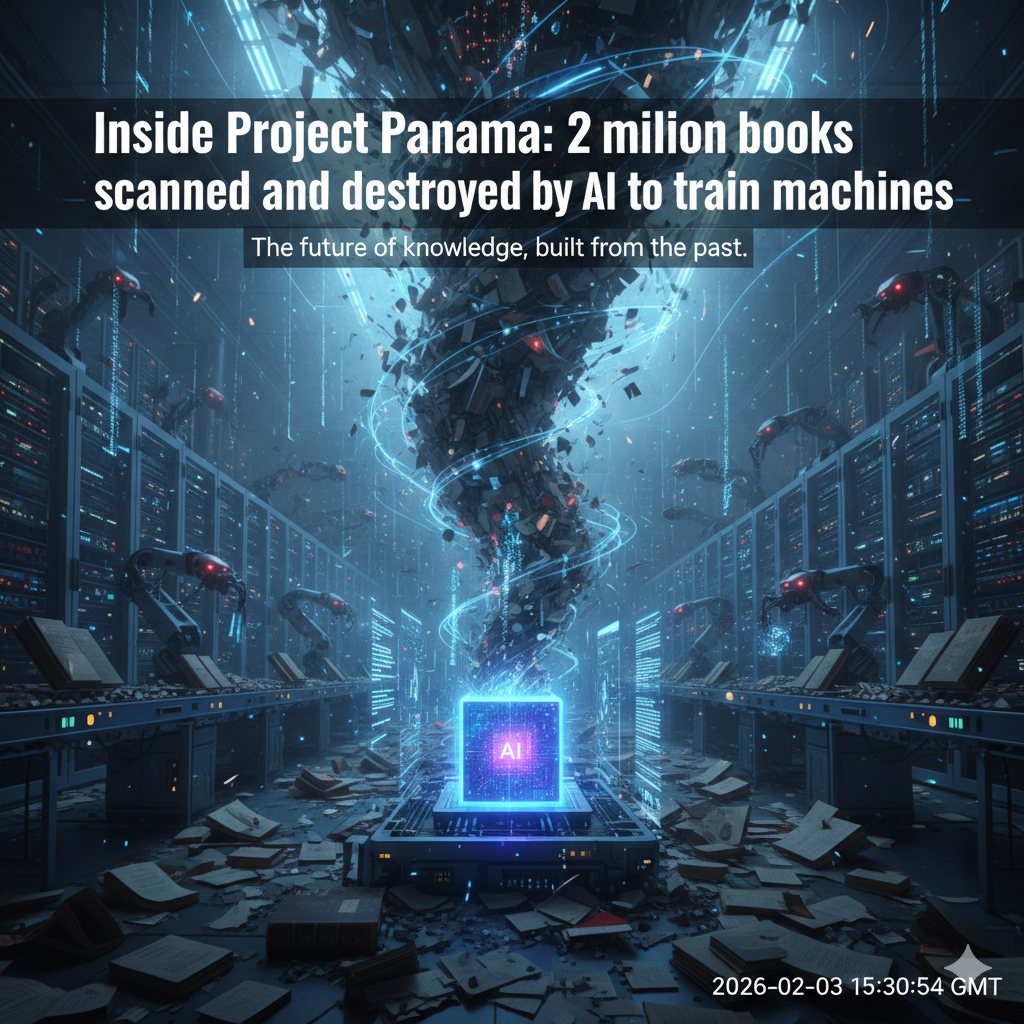
Project Panama forces us to confront that reality directly.
It reveals not just how AI systems are trained, but how value, ownership, labour, and ethics are being renegotiated in the age of intelligent machines.
From Digital Abundance to Data Scarcity
For years, AI development benefited from what appeared to be an endless supply of digital data. The open web provided text, images, and conversations at massive scale. But as models grew more capable, a limitation became clear: quantity alone was no longer enough.
Low-quality, repetitive, and shallow data produces brittle intelligence.
To push beyond surface-level pattern matching toward reasoning, explanation, and synthesis, AI systems require dense, structured, and carefully curated knowledge. Books represent the highest concentration of this kind of data ever produced by humans.
Project Panama signals a shift from data abundance to data scarcity — where high-quality knowledge becomes the most valuable and contested resource in AI development.
Books as Cognitive Infrastructure
Books are not just containers of information. They encode:
- •Chains of reasoning developed over decades
- •Disciplinary frameworks and mental models
- •Cultural memory and historical context
- •Editorial discipline and intellectual rigor
When machines are trained on books, they are not simply learning language. They are absorbing how humans think, argue, teach, and explain.
This reframes books as a form of cognitive infrastructure — foundational assets that shape how future intelligence, both human and artificial, operates.
Destroying physical copies after digitisation may be efficient, but it symbolises a deeper transformation: knowledge is being detached from its physical, cultural, and institutional roots and reabsorbed into proprietary systems.
The Industrialisation of Learning
Project Panama also exposes the industrial nature of modern AI training. Learning, once a human-centred process, is now executed through supply chains, logistics, and automation.
This pipeline includes:
- •Acquisition of intellectual material
- •Conversion into machine-readable form
- •Large-scale computational processing
- •Integration into closed, monetised systems
What was once slow, reflective, and contextual becomes fast, extractive, and optimised for scale.
The danger is not the technology itself, but the logic of industrial efficiency applied to knowledge, where speed and competitive advantage override questions of stewardship, preservation, and reciprocity.
Ownership, Transformation, and Moral Distance
A central tension raised by Project Panama lies in the gap between legal ownership and moral responsibility.
Owning a physical book has traditionally granted the right to read, annotate, resell, or discard it. But training machines on books introduces a new dimension: the conversion of personal ownership into systemic economic advantage.
The act is legally framed as transformation. Yet morally, it raises difficult questions:
- •Should individual ownership enable collective extraction of value?
- •Does transformation erase the origin of knowledge?
- •At what point does learning become appropriation?
The scale involved creates moral distance. Decisions that would feel uncomfortable at a small scale become normalised when executed by machines, vendors, and automated pipelines.
Power Asymmetry in the Knowledge Economy
Project Panama also reveals a growing asymmetry in the global knowledge economy.
A small number of organisations now possess:
- •The capital to acquire and process vast knowledge reserves
- •The infrastructure to convert them into machine intelligence
- •The ability to monetise that intelligence at global scale
Meanwhile, authors, educators, researchers, and entire regions contribute knowledge without proportional influence over how it is used or valued.
This asymmetry matters deeply for Africa and other emerging economies. If knowledge produced globally is absorbed into AI systems owned elsewhere, intellectual extraction may replace resource extraction as the dominant economic pattern of the digital age.
Implications for Education and Skill Development
For education providers, Project Panama carries an uncomfortable but important message: depth still matters.
AI systems are turning to books because shallow learning does not scale. The same principle applies to human learners.
Surface-level training produces:
- •Fragile skills
- •Limited transferability
- •Rapid obsolescence
Deep learning — grounded in fundamentals, reasoning, and context — produces resilience. As machines move toward deeper intelligence, human education must do the same, or risk irrelevance.
A Question of Direction, Not Capability
The most important lesson of Project Panama is not about what AI can do, but about what direction we choose.
Technology reflects values. The systems we build today will shape how knowledge is created, preserved, and rewarded tomorrow.
The real question is not whether machines should learn from books, but whether societies can design frameworks that:
- •Respect knowledge creators
- •Preserve cultural memory
- •Distribute value more equitably
- •Align innovation with long-term human benefit
Final Reflection
Project Panama is a mirror.
It reflects our priorities, our incentives, and our assumptions about progress. It reminds us that intelligence — artificial or human — is never free. It is built from accumulated effort, culture, and time.
The future will not be defined by how much data machines consume, but by how responsibly we transform knowledge into intelligence.
That responsibility belongs not just to technologists, but to educators, policymakers, institutions, and societies at large.
TLedu Ghana
Author at Tledu Ghana
Comments (0)
No comments yet. Be the first to share your thoughts!