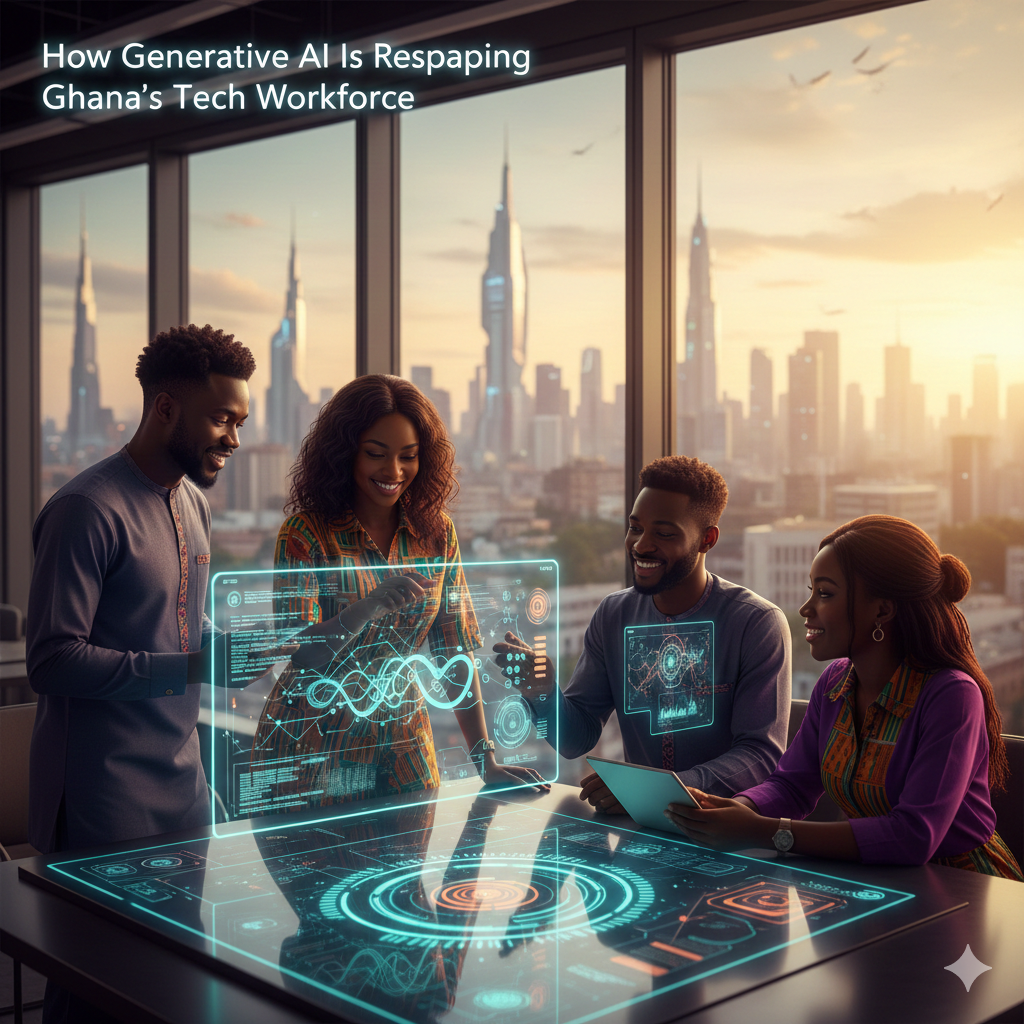
How Generative AI Is Reshaping Ghana's Tech Workforce
A quiet revolution is happening in Osu's co-working spaces and East Legon home offices. Last quarter, a local fintech startup secured a $500,000 contract with a European bank by delivering their prototype in three weeks instead of the projected three months. Their secret weapon wasn't more developers working longer hours it was their strategic adoption of generative AI coding assistants.
This isn't about replacing programmers; it's about amplifying their capabilities. While global headlines focus on Silicon Valley, Ghanaian developers are quietly integrating these tools into workflows that account for our unique challenges from intermittent internet connectivity to solving problems specific to African markets.
The Accra Developer Who Doubled His Output
Meet Kwame (name changed for privacy), a senior developer at an Accra-based software agency. Six months ago, his team struggled with tight deadlines for a mobile banking app serving rural communities. "We were writing boilerplate code for authentication screens that took days," he explains. "Then we started using GitHub Copilot alongside our existing Visual Studio Code setup."
The transformation was immediate but required adaptation. Kwame didn't just accept every suggestion; he learned to write better prompts clear comments describing what functions should accomplish in plain English mixed with Twi technical terms his team understood. Suddenly, generating complete form validation logic or API endpoint structures became minutes instead of hours.
"The real breakthrough came when we needed to integrate with multiple mobile money providers," Kwame continues. "The AI suggested patterns we hadn't considered, drawing from global open-source projects but adaptable to MTN and AirtelTigo APIs specifically."
Their project delivery speed increased by 60%, allowing them to take on two additional clients while maintaining quality. More importantly, junior developers on Kwame's team accelerated their learning by studying the AI-generated code patterns and understanding why certain solutions worked better than others.
Practical Integration for Ghanaian Developers
The key isn't having the tool it's knowing how to use it effectively within our context:
Start With Specific Problems Don't try to use AI for everything immediately. Identify repetitive tasks in your current projects: form validations, data model definitions, or standard API routes. These predictable patterns give you controlled environments to test AI suggestions without risking critical business logic.
Develop Localized Prompts Generic prompts yield generic results. When working on applications for Ghanaian users, include context in your comments: "// Function to validate Ghanaian phone number format including MTN, Vodafone, AirtelTigo prefixes" produces more relevant code than simply asking for phone validation.
Maintain Human Review Cycles Establish mandatory review checkpoints where senior developers examine AI-generated code before integration. This catches potential issues early while training both the team and improving future prompt specificity.
Build Custom Snippets Library As you refine effective prompts and receive useful code blocks, save them as custom snippets within your editor. This creates an institutional knowledge base that remains accessible even during internet outages common in parts of Accra during rainy seasons.
Focus On Learning Acceleration Use generated code as educational material rather than just production-ready solutions. When the AI suggests an unfamiliar algorithm or design pattern, research why it works before implementing it—turning each suggestion into a mini-lesson that builds deeper expertise.
The most successful teams treat these tools as collaborative partners rather than automation magic wands.
TLedu Ghana
Author at Tledu Ghana
Comments (0)
No comments yet. Be the first to share your thoughts!